Serving St. Louis & Surrounding Areas

Keep Your Business Running with Commercial HVAC Maintenance in Oakville
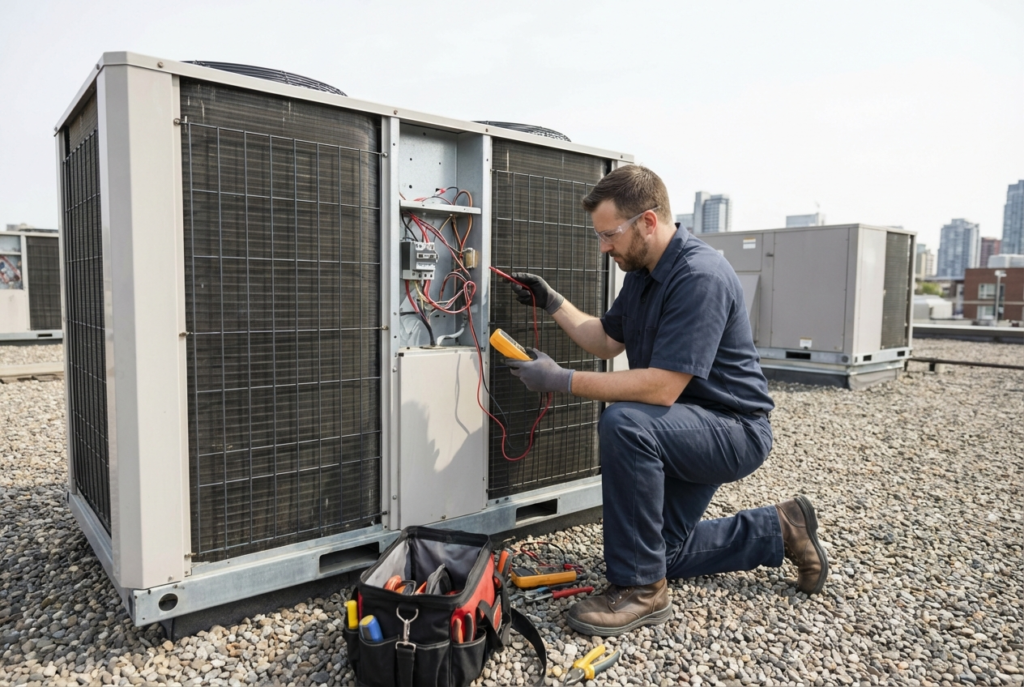
Your rooftop HVAC unit runs all day every weekday keeping your building comfortable. No breaks. No time off. Just constant work heating and cooling your office or store. Commercial HVAC maintenance in Oakville keeps that hard-working equipment running without surprise breakdowns. We check everything twice a year so small problems get fixed before they shut down your business. Clean filters mean better airflow. Proper refrigerant levels mean efficient cooling. Tight electrical connections mean no failures. Regular maintenance beats emergency repairs every time.
Our Commercial HVAC Maintenance in Oakville – What Actually Gets Checked
What a Commercial HVAC Tune-Up Actually Covers
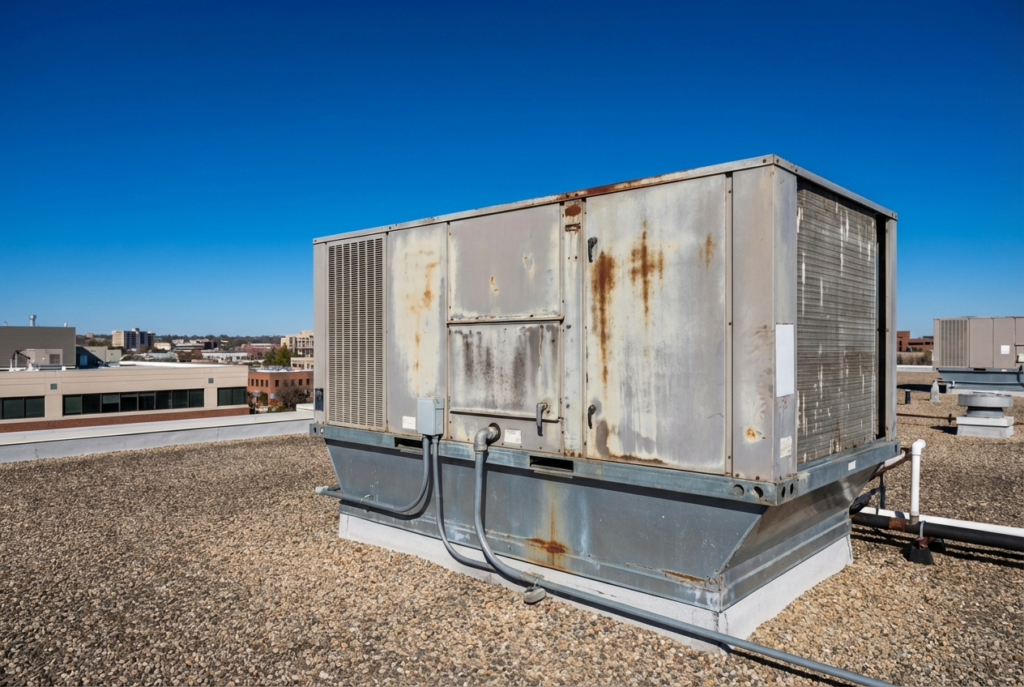
A commercial HVAC tune-up isn’t a technician glancing at your unit for 20 minutes and handing you an invoice. A real maintenance visit covers the mechanical, electrical, and refrigerant sides of your system — all in one visit. Most commercial rooftop units have dozens of components that wear down quietly over months. You won’t notice until something fails.
On the mechanical side, the tech checks belts, bearings, and motors. A worn belt doesn’t announce itself — it just snaps one day in July when your building is full of customers. Bearings get lubricated so motors don’t overheat. Drain pans and condensate lines get cleared so water doesn’t back up into the unit or your ceiling.
Electrical connections get checked and tightened. Loose connections cause voltage spikes that burn out components. Capacitors and contactors get inspected because those are the parts that fail most often and strand businesses without cooling on the hottest days of the year. Refrigerant levels get checked too — low refrigerant means the system works harder and cools less, which shows up on your utility bill long before it shows up as a breakdown.
How Often Commercial Systems Need Maintenance
Most commercial HVAC systems need service twice a year — once in spring before cooling season, and once in fall before heating season. That schedule isn’t arbitrary. It lines up with when your system shifts into its heaviest workload. Catching problems right before peak season means you’re not scrambling for a technician when every HVAC company in the area is booked out three days.
Some buildings need more frequent visits. A restaurant kitchen with grease in the air needs quarterly filter changes at minimum. A medical office with strict air quality requirements might need monthly filter checks on top of the standard twice-a-year tune-ups. A retail space with high foot traffic runs its system harder than a small professional office. The right schedule depends on your building type and how hard your equipment actually works.
Skipping a year isn’t a neutral decision — it’s a choice to let small problems grow. A refrigerant leak that costs $300 to fix in the spring becomes a compressor replacement that costs $3,000 by August. Businesses that stay on a regular tune-up schedule rarely call us needing urgent same-day service in the middle of summer. The ones that do are almost always systems that missed their spring visit.
What Skipped Maintenance Actually Costs You
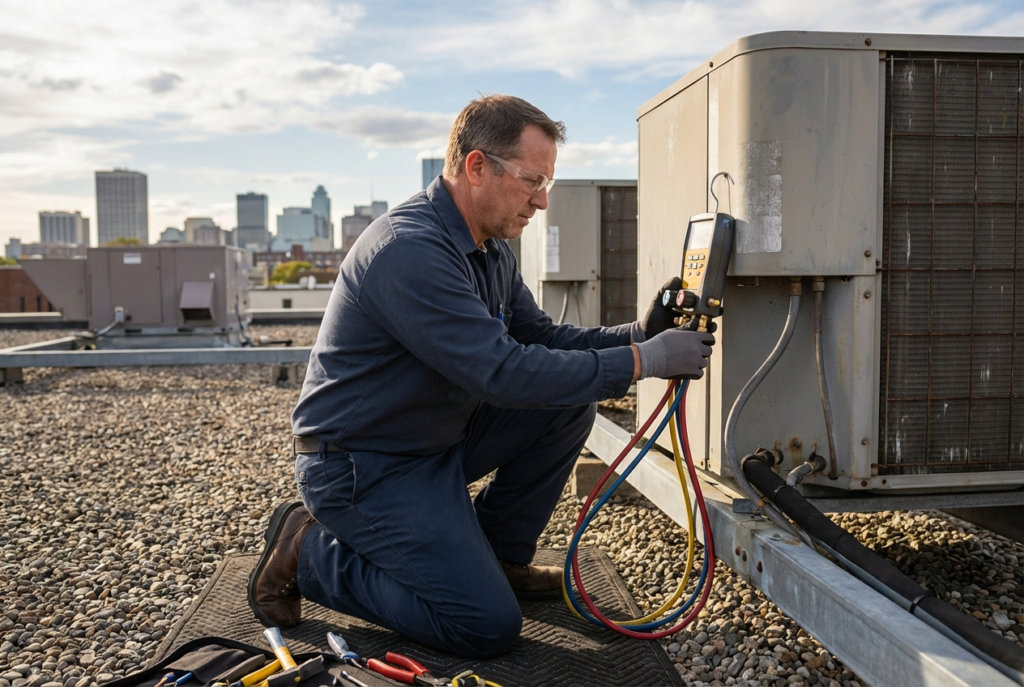
The math on skipped maintenance is pretty simple. A twice-yearly commercial maintenance agreement runs somewhere in the range of $400-800 per year depending on your system size and how many units you have. An emergency service call starts at $175-250 just to show up. A compressor replacement on a commercial rooftop unit runs $2,500-5,000. A full unit replacement because a repairable problem got ignored runs $8,000-15,000 or more.
There’s also the business cost that doesn’t show up on an HVAC invoice. A retail store that loses cooling on a 95-degree Saturday loses sales. An office building with no heat in February sends employees home. A restaurant that can’t maintain safe food temperatures closes for the day. Those losses aren’t covered by your HVAC warranty — they’re just gone. According to the U.S. Department of Energy, regular maintenance keeps AC systems running at near-peak efficiency, while neglected units lose efficiency every year without service.
Deferred maintenance also shortens equipment life. Commercial rooftop units that get regular service routinely last 15-20 years. The same unit that gets ignored typically needs replacement in 10-12 years. That’s $10,000-15,000 in replacement cost you’re pulling forward by skipping a few hundred dollars a year in upkeep. When it does get to that point, knowing what a full replacement actually involves helps you plan instead of react.
IMAGE 3 — After this H3
Why Commercial Maintenance Is Different from Residential
Commercial HVAC systems aren’t just bigger residential systems. They’re fundamentally different equipment with different components, different failure modes, and different stakes when something goes wrong. A residential tech who mostly works on home furnaces and split systems isn’t automatically qualified to maintain a commercial rooftop package unit or a multi-zone VAV system.
Commercial systems deal with higher voltage, larger refrigerant charges, and more complex controls. Zone dampers, economizers, building automation system connections, and variable frequency drives don’t exist on most residential equipment. A tech who doesn’t work on these regularly can miss problems that an experienced commercial tech spots immediately. If you’re getting a quote from a contractor, ask them directly what percentage of their business is commercial work. The answer tells you a lot.
Different equipment manufacturers have different service requirements. Carrier rooftop units, Lennox commercial equipment, and Trane systems all have specific maintenance protocols. A good commercial tech knows those differences and services each unit to manufacturer specs rather than running through a one-size-fits-all checklist. That distinction matters when you’re trying to protect a system worth $10,000 or more.
Spotting Early Warning Signs Between Service Visits
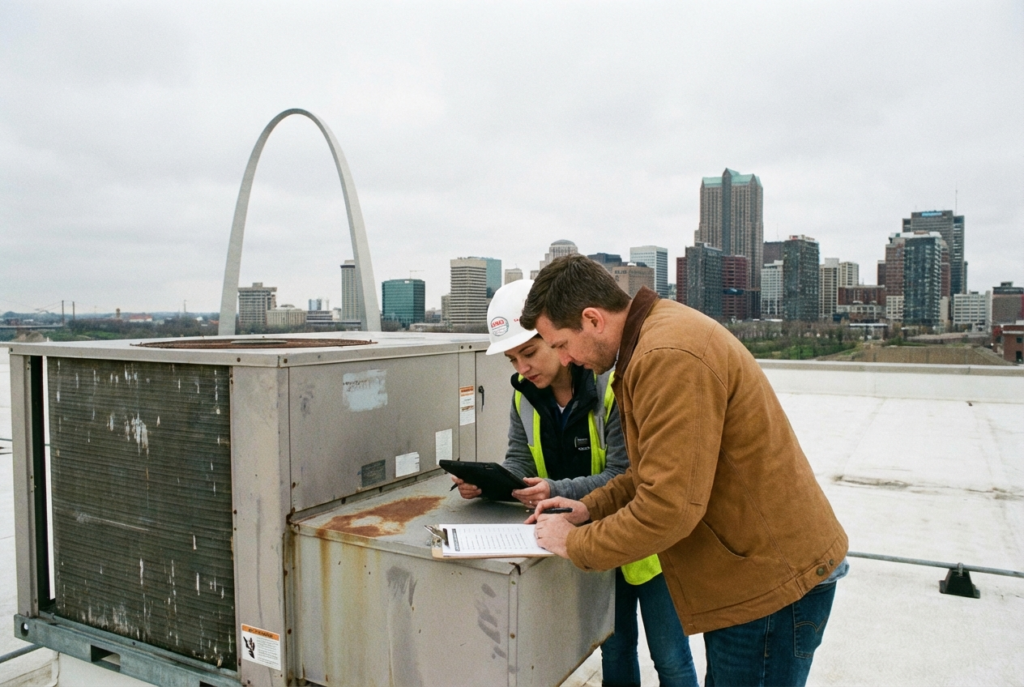
Twice-yearly maintenance catches most problems, but your system runs 52 weeks a year. Knowing what to watch for between visits can prevent a small issue from turning into a shutdown. You don’t need to be an HVAC technician to recognize the early signs that something is off.
Unusual noises are the most obvious signal. Rattling usually means a loose panel or failing component. Grinding means bearings. Squealing means a belt that’s about to go. Any noise that wasn’t there last month and is there this month is worth a call. Don’t wait for the next scheduled visit — unusual sounds usually get worse, not better.
Higher-than-normal utility bills without an obvious explanation are another sign. If your electric bill jumps 15-20% without a weather explanation, your system is probably working harder than it should. That’s often low refrigerant, dirty coils, or a failing component dragging down efficiency. A quick diagnostic call is a lot cheaper than waiting until you have no cooling at all. If it gets to that point, getting someone out the same day is always an option — but it’s a situation regular maintenance almost always prevents.
IMAGE 4 — After this H3
What a Real Maintenance Contract Actually Looks Like
The Difference Between a Tune-Up and a Checkbox Visit
Not every maintenance visit is equal. Some contractors show up, swap a filter, check a few boxes on a form, and call it done in 45 minutes. That’s not maintenance — that’s paperwork. A real commercial tune-up takes 2-3 hours depending on system size. If your tech is back in the van in under an hour, something got skipped.
Ask for a written scope of work before anyone touches your equipment. A legitimate maintenance agreement spells out exactly what gets checked, cleaned, tested, and adjusted on every visit. Electrical testing, refrigerant pressure checks, coil cleaning, belt tension, drain line clearing — it should all be listed. If a contractor hands you a one-page agreement with vague language about “full inspection,” push for specifics or find someone else.
Also ask what happens when they find something during the visit. Some contractors use maintenance calls as sales opportunities — flagging minor issues as urgent replacements to pad the invoice. A trustworthy contractor explains what they found, tells you what needs attention now versus what can wait, and gives you a written estimate before doing anything extra. You should never get a surprise charge after a maintenance visit.
What to Ask Before Signing a Maintenance Agreement
The contract matters as much as the work. Before you sign anything, find out if the agreement includes priority scheduling for repairs. Some maintenance agreements are just annual visit reminders with no other benefit. A real commercial maintenance contract should get you to the front of the line when something breaks — because the whole point of maintenance is protecting your operations, and a contractor who maintains your system should be the one who fixes it when problems come up.
Ask about technician consistency too. Commercial systems are complicated and every building is a little different. A tech who has been to your building twice already knows your equipment, knows your quirks, and can spot changes faster than someone seeing it for the first time. High-turnover shops send whoever is available. That’s fine for a one-time repair but it’s a problem for ongoing maintenance relationships.
Find out if they stock parts for your equipment. A contractor who works on commercial systems regularly keeps common components on the truck — capacitors, contactors, belts, filters. A contractor who has to order everything means longer downtime when something does fail. That matters a lot more for a commercial building than it does for a home.
Why 27 Years in Oakville Makes a Difference
Liberty Heating Cooling & Plumbing has been working on commercial and residential systems in Oakville for 27 years. That’s not a marketing line — it means we’ve seen the inside of most equipment types that get installed in this area, and we’ve been maintaining some of the same buildings for over a decade. We know what local commercial buildings deal with — hot Missouri summers that push rooftop units hard, cold winters that stress heating systems, and the humidity swings in between that cause their own set of problems.
We don’t treat maintenance visits like oil changes. When we find something, we explain it in plain language, show you what we’re looking at if we can, and let you decide how to proceed. No pressure, no manufactured urgency. If something can wait until next quarter, we’ll tell you that. If something needs attention now, we’ll tell you why.
Our maintenance agreements are straightforward — twice-yearly visits, written scope, documented findings after every visit, and priority scheduling if something comes up in between. You know what you’re getting and what it costs before we start.
Call (314) 600-2202 to schedule commercial HVAC maintenance in Oakville. We keep your equipment running so your business doesn’t have to stop.